By Ray Padilla | Founder and President, Ray Padilla Law, APC
Last Updated: March 2026
Pedestrian right of way laws in California determine who has priority at crosswalks, intersections, and roadways throughout San Diego County. Understanding these laws is critical after a pedestrian accident in San Diego, because fault is not always straightforward. Drivers, pedestrians, and even government entities may share responsibility depending on the circumstances. Ray Padilla Law, APC, a San Diego personal injury firm led by California licensed attorney Ray Padilla (admitted 2012), represents pedestrians injured in collisions throughout San Diego County, including crosswalk accidents, intersection crashes, and parking lot incidents.
California’s pedestrian laws require drivers to yield to pedestrians in specific situations, but pedestrians also have legal duties. When either party fails to follow the rules, California’s comparative fault system determines how liability is allocated. This guide explains the key laws, how fault is determined, and what steps to take if you are injured as a pedestrian in San Diego.
Key Takeaways
- Under California Vehicle Code section 21950, drivers must yield the right of way to pedestrians in both marked and unmarked crosswalks.
- Pedestrians also have legal duties, including not suddenly stepping into the path of a vehicle that cannot reasonably stop.
- California follows a pure comparative negligence system, meaning a pedestrian can still pursue a claim even if partially at fault.
- The Freedom to Walk Act (AB 2147), effective January 1, 2023, changed how jaywalking is enforced in California. Officers can only cite pedestrians for crossing outside a crosswalk when there is an immediate danger of a collision.
- Pedestrian accidents in San Diego can result in serious injuries. Preserving evidence and seeking legal and medical attention promptly are important steps.
What Is the Pedestrian Right of Way Law in California?
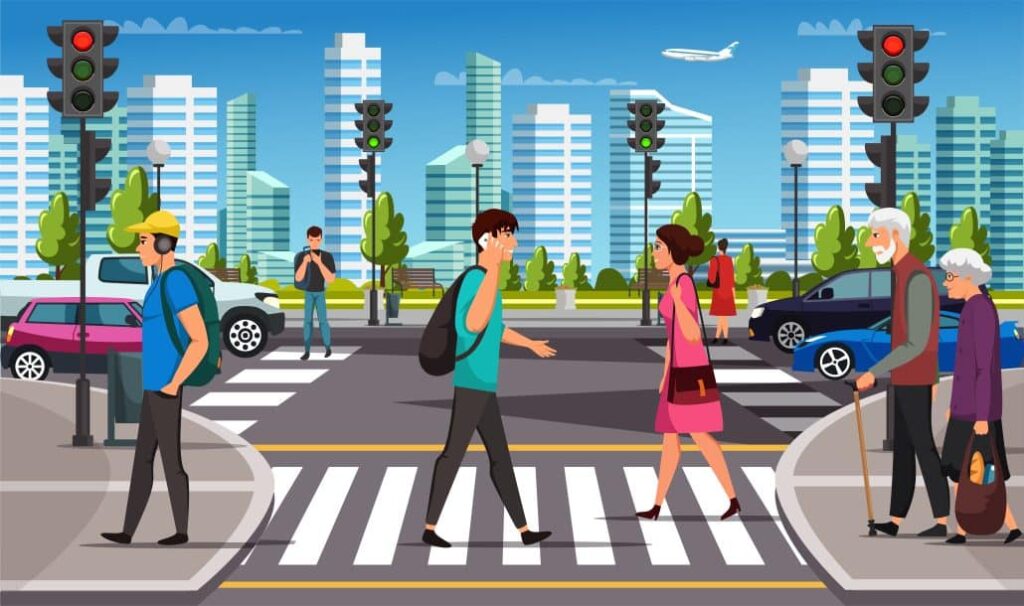
California Vehicle Code section 21950 is the primary statute governing pedestrian right of way. It requires drivers to yield the right of way to pedestrians crossing the roadway within any marked crosswalk or within any unmarked crosswalk at an intersection. This applies even when the crosswalk lines are not painted on the road surface. Under California law, an unmarked crosswalk exists at every intersection where two roads meet, unless signs or signals indicate otherwise.
However, the law also places responsibilities on pedestrians. Under Vehicle Code section 21950(b), pedestrians cannot suddenly leave a curb or other place of safety and walk or run into the path of a vehicle that is close enough to constitute an immediate hazard. Pedestrians must also exercise “due care” for their own safety. Both drivers and pedestrians have obligations under California law, and a violation by either party can affect fault allocation.
Unmarked crosswalk: Under California law, an unmarked crosswalk is the natural extension of a sidewalk or shoulder across an intersection, even when no painted lines are present. Drivers must yield to pedestrians in unmarked crosswalks the same way they yield in marked crosswalks.
What Crosswalk Laws Apply to Drivers in San Diego?
San Diego has a high volume of pedestrian traffic, particularly in areas like Downtown San Diego, the Gaslamp Quarter, Pacific Beach, Little Italy, Balboa Park, and near schools and university campuses. Drivers operating vehicles in these areas must be aware of several California Vehicle Code provisions that apply to crosswalks and intersections.
Driver Obligations Under California Law
- Yield to pedestrians in both marked and unmarked crosswalks (Vehicle Code section 21950).
- Stop for pedestrians at intersections, even when no traffic signal is present.
- Do not pass a vehicle stopped at a crosswalk. Under Vehicle Code section 21951, a driver approaching from behind must stop before reaching the crosswalk. The stopped vehicle may be yielding to a pedestrian who is not visible to approaching traffic.
- Exercise due care to avoid colliding with a pedestrian on a roadway (Vehicle Code section 21954(b)). This duty applies regardless of whether the pedestrian has the right of way.
- Use extra caution near schools (Vehicle Code section 21950 and local school zone regulations), parks, and residential neighborhoods in San Diego County.
What Legal Duties Do Pedestrians Have in California?
While California law provides significant protections for pedestrians, it also imposes legal duties that affect fault analysis. Pedestrians who violate these duties may be assigned a percentage of fault under California’s comparative negligence system, which can reduce the amount of compensation recovered in a personal injury claim.
- Obey pedestrian signals at signalized intersections (Vehicle Code section 21456). Crossing against a “Do Not Walk” or countdown signal when vehicles are approaching can establish fault.
- Do not suddenly leave a curb or place of safety and enter the path of a vehicle that is close enough to constitute an immediate hazard (Vehicle Code section 21950(b)).
- Use crosswalks when reasonably available. While crossing outside a crosswalk is not automatically illegal under the Freedom to Walk Act, pedestrians must still exercise due care.
- Stay alert. Distracted walking, including using a phone while crossing a busy San Diego street, does not excuse a driver’s duty of care, but it can be raised as a factor in fault allocation.
Is Jaywalking Legal in California After the Freedom to Walk Act?
California’s jaywalking laws changed significantly when the Freedom to Walk Act (Assembly Bill 2147) took effect on January 1, 2023. Under AB 2147, which amended Vehicle Code sections 21954 and 21955, law enforcement officers can only stop and cite a pedestrian for crossing outside a crosswalk or against a traffic signal when a reasonably careful person would realize there is an immediate danger of a collision with a moving vehicle.
This means that crossing a street mid-block is not automatically a citable offense in California if it can be done safely. However, the Freedom to Walk Act does not eliminate a pedestrian’s civil liability. If a pedestrian crosses unsafely outside a crosswalk and contributes to a collision, comparative fault principles still apply. The pedestrian’s recovery may be reduced by their percentage of responsibility.
Importantly, even when a pedestrian is crossing outside a crosswalk, San Diego drivers still have a duty under Vehicle Code section 21954(b) to exercise due care to avoid colliding with a pedestrian on a roadway. A driver who fails to slow down, yield, or take evasive action when a pedestrian is visible may still be found at fault or share fault for the collision.
How Is Fault Determined in a San Diego Pedestrian Accident?
Comparative negligence: California follows a pure comparative negligence system. This means an injured pedestrian may recover compensation even if they were partially at fault for the accident. The amount of compensation is reduced by the pedestrian’s percentage of fault. For example, if a pedestrian is found 20% at fault and the total damages are $100,000, the pedestrian may recover up to $80,000.
Fault in a pedestrian accident is determined by evaluating the actions of all parties against their legal duties. Common factors that affect fault allocation in San Diego pedestrian cases include the following.
| Factor Indicating Driver Fault | Factor Indicating Pedestrian Fault |
| Failure to yield at a marked or unmarked crosswalk | Suddenly entering the roadway in front of a vehicle |
| Speeding or driving too fast for conditions | Crossing against a pedestrian signal |
| Distracted driving (phone use, inattention) | Distracted walking (phone use, headphones) |
| Running a red light or stop sign | Crossing outside a crosswalk when unsafe to do so |
| Failure to stop behind a vehicle yielding at a crosswalk | Walking while impaired by alcohol or drugs |
| Driving under the influence | Wearing dark clothing at night with no visibility aids |
| Failing to exercise due care when pedestrian is visible | Ignoring safety barriers or construction zones |
Because California uses pure comparative negligence, fault is rarely all-or-nothing in pedestrian cases. Both parties may share responsibility, and the specific facts of the accident, including witness statements, surveillance footage, police reports, and physical evidence, determine how fault is allocated.
A Pattern I See in San Diego Pedestrian Cases
In my practice, I see a recurring pattern in San Diego pedestrian cases: the driver or their insurance representative argues that the pedestrian “came out of nowhere” to shift blame. In many of these cases, a closer look at the evidence tells a different story. Surveillance camera footage, intersection geometry, lighting conditions, and vehicle speed data often show that the driver had time and opportunity to yield or stop.
Another issue I encounter frequently involves unmarked crosswalks. Many drivers and even some adjusters do not realize that every intersection in California has a legal crosswalk, whether or not it is painted. When we can establish that the pedestrian was crossing within an unmarked crosswalk and the driver failed to yield, the case dynamics change significantly. This is why early evidence preservation, including requesting intersection camera footage and documenting the scene, is so important in pedestrian accident claims.
— Ray Padilla, Founder, Ray Padilla Law, APC
What Compensation Can Pedestrian Accident Victims Recover in California?
Pedestrian accidents often result in severe injuries because the person on foot has no protection against the force of a vehicle. Under California law, injured pedestrians may pursue compensation for both economic and non-economic damages. The specific damages available in a California personal injury claim depend on the facts of each case, but generally include the following categories.
- Emergency medical treatment and hospitalization costs
- Surgical procedures and ongoing medical care
- Physical therapy and rehabilitation
- Lost wages and reduced earning capacity
- Pain and suffering
- Emotional distress
- Permanent disability or disfigurement
- Wrongful death damages for surviving family members when a pedestrian accident is fatal
In cases involving fatal pedestrian accidents, California’s wrongful death laws allow certain family members to pursue a claim. Every case is different, and results depend on the specific facts and applicable law.
What Should You Do After a Pedestrian Accident in San Diego?
Taking the right steps after a pedestrian accident can protect both your health and your legal options. The following steps are consistent with general guidance for what to do after an accident in San Diego.
- Step 1: Call 911 and seek medical attention. Pedestrian injuries can be severe and may not be fully apparent at the scene. A police report also creates an official record of the accident.
- Step 2: Document the scene. If you are able, take photographs of the intersection, crosswalk markings (or lack of them), traffic signals, vehicle positions, and any visible injuries. Collect contact information from witnesses.
- Step 3: Do not provide detailed statements to the driver’s insurance company. Adjusters may ask leading questions designed to establish pedestrian fault. Before making any recorded statement, understand your rights.
- Step 4: Preserve evidence. Request copies of surveillance or traffic camera footage from nearby businesses or the city. This footage may be overwritten within days if not requested promptly.
- Step 5: Follow your medical treatment plan. Attend all scheduled appointments. Gaps in treatment can be used to argue that injuries were not serious or not caused by the accident.
- Step 6: Speak with a personal injury attorney. A San Diego pedestrian accident attorney can evaluate the evidence, determine how right of way and comparative fault apply to your situation, and help protect the value of your claim.
Frequently Asked Questions About Pedestrian Right of Way in San Diego
Do pedestrians always have the right of way in California?
No. While drivers must yield to pedestrians in marked and unmarked crosswalks under Vehicle Code section 21950, pedestrians also have duties. A pedestrian who suddenly enters the roadway in front of a vehicle that cannot reasonably stop may be assigned fault. California’s comparative negligence system allocates responsibility based on each party’s actions.
What is an unmarked crosswalk in California?
An unmarked crosswalk is the natural extension of a sidewalk or shoulder across an intersection, even when no painted lines are present. Under California law, drivers must yield to pedestrians in unmarked crosswalks the same as in marked crosswalks. Many drivers are unaware that these crosswalks exist at every standard intersection.
Can I file a claim if I was partially at fault for the pedestrian accident?
Yes. California follows a pure comparative negligence rule. Your compensation may be reduced by your percentage of fault, but you are not barred from recovery. For example, a pedestrian found 30% at fault could still recover 70% of total damages.
Has California legalized jaywalking?
The Freedom to Walk Act (AB 2147), effective January 1, 2023, changed enforcement of jaywalking laws. Officers can only cite pedestrians for crossing outside a crosswalk when there is an immediate danger of collision. The law does not eliminate civil liability, and crossing unsafely can still affect fault in a personal injury claim.
What is the statute of limitations for a pedestrian accident lawsuit in California?
In most cases, the statute of limitations for a personal injury lawsuit in California is two years from the date of the accident under Code of Civil Procedure section 335.1. If a government entity is involved, shorter deadlines may apply, including a six-month administrative claim deadline under the Government Claims Act.
What if a pedestrian accident in San Diego involves a city-owned road or traffic signal?
Claims against a government entity in California require filing an administrative claim within six months under Government Code sections 810 through 996.6. This is a significantly shorter deadline than the standard two-year statute of limitations. Missing the government claim deadline can bar the claim entirely.
Can a driver be at fault even if the pedestrian was not in a crosswalk?
Yes. Under Vehicle Code section 21954(b), drivers must exercise due care to avoid colliding with any pedestrian on a roadway, regardless of whether the pedestrian is in a crosswalk. A driver who was speeding, distracted, or impaired may be found at fault or share fault even if the pedestrian was crossing outside a crosswalk.
Speak with a San Diego Pedestrian Accident Attorney About Your Case
Pedestrian accidents in San Diego County can cause life-changing injuries. Before discussing your accident with an insurance adjuster, it helps to understand how California’s right of way laws and comparative fault rules apply to your specific situation.
Ray Padilla Law, APC represents pedestrians injured in collisions throughout San Diego County, including crosswalk accidents, intersection crashes, and hit-and-run incidents. Ray Padilla works directly with clients from investigation through resolution and prepares every case with trial readiness in mind.
Request a confidential case evaluation or call (619) 431-1187 to discuss your situation with Attorney Ray Padilla. Services are available in English and Spanish.
About the Author
Ray Padilla Founder and President, Ray Padilla Law, APC California Licensed Attorney (Admitted 2012) San Diego, California
Ray Padilla is a San Diego personal injury attorney focused on serious car accidents, motorcycle crashes, rideshare collisions, pedestrian and bicycle accidents, truck accidents, and wrongful death cases. Since founding Ray Padilla Law, APC in 2016, he has represented individuals and families throughout San Diego County in complex injury litigation. Ray emphasizes a settlement-first strategy supported by thorough trial preparation and provides services in both English and Spanish.
Legal Disclaimers
Educational Purpose Disclaimer: This content is provided for general informational and educational purposes only. It does not constitute legal advice. Reading this material does not create an attorney-client relationship. Laws change and every case depends on specific facts. You should consult a qualified attorney regarding your individual situation.
No Attorney-Client Relationship: Contacting Ray Padilla Law, APC through this website, email, text message, or online form does not create an attorney-client relationship. An attorney-client relationship is formed only after a written agreement is signed by both the client and the firm.
No Guarantee of Outcome: While we prepare every case thoroughly and advocate aggressively within the law, no attorney can guarantee a specific result. Case outcomes depend on many factors including evidence, liability, insurance coverage, and applicable law.
Statute of Limitations Notice: Deadlines under California law can vary based on the type of claim and the parties involved. Government claims and cases involving minors may follow different rules. You should seek legal advice promptly to protect your rights.
Jurisdictional Notice: Ray Padilla Law, APC is located in San Diego, California and represents clients in matters governed by California law. Information on this website is intended to apply to California legal matters unless otherwise stated.